Knowledge
Prop 65 Isn't a Formality. A Tea Brand Just Got Served Over Lead
The number that decides if your tea needs a warning.
By Grace Luo · reviewed by Leon Liang · July 29, 2026 · 5 min read

Most Chinese tea exporters view California’s Prop 65 warning labels as boilerplate. Because the state requires warnings on everything from coffee to parking garages, the general consensus is that nobody reads them and they don’t reflect the actual quality of the tea. That is a correct assessment of the label’s reputation, but a dangerous misunderstanding of the law behind it.
The short answer is two facts:
- Proposition 65 is a California warning-and-disclosure law. It is not an FDA import rule, and it does not travel with an FDA refusal or warning letter.
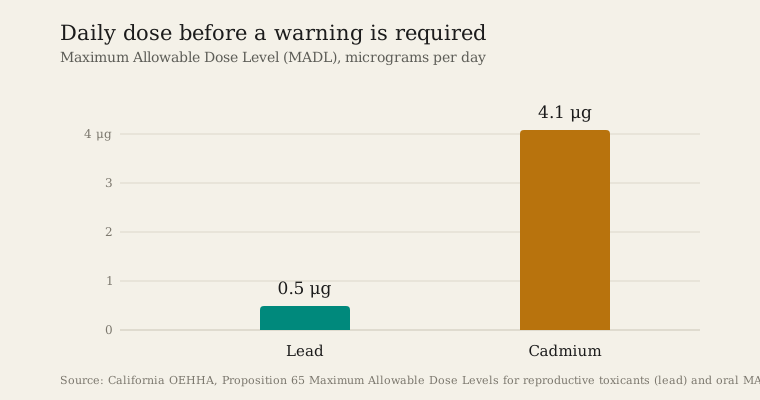
- For lead, the reproductive MADL that typically triggers a warning is 0.5 micrograms per day; for oral cadmium it is 4.1 micrograms per day.
California’s Office of Environmental Health Hazard Assessment (OEHHA) sets a Maximum Allowable Dose Level (MADL) for listed chemicals. If a product exceeds this level, a warning is legally required.
For lead and cadmium, the binding numbers are:
- Lead (Reproductive Toxicity): 0.5 micrograms per day. (While a separate cancer-risk threshold exists at 15 micrograms, the lower reproductive limit is what typically triggers the warning).
- Cadmium (Oral): 4.1 micrograms per day.
On July 21, 2026, The Living Gallery, LLC filed a 60-day notice of violation against Chaivio, LLC and Walmart, Inc. The claim concerns lead levels in Chaivio Instant Tea, specifically its Spiced Milk Tea Masala Chai. Filed under California Health and Safety Code section 25249.7(d), this notice is a public record and a precursor to a settlement or lawsuit if not resolved.
Note: This is an allegation, not a finding of wrongdoing. Easterlies has no relationship with the parties involved; we are citing this as an independently verifiable case study.
What Prop 65 Actually Requires
Proposition 65 (the Safe Drinking Water and Toxic Enforcement Act of 1986) requires any business with ten or more employees to provide a “clear and reasonable warning” before knowingly exposing Californians to chemicals listed as causing cancer or reproductive harm. Lead and cadmium have been on this list for decades.
It is critical to distinguish Prop 65 from other regulations: Prop 65 is a disclosure law. It operates independently of FDA rules or food-safety findings like import refusals and warning letters.
A product can be entirely legal to sell and still require a warning. Conversely, adding a warning does not mean a product failed a safety test. The requirement is triggered by a specific number, not a general sense of caution.
The Thresholds: MADL
These thresholds are intentionally low. If a single serving exceeds these limits, even slightly, a warning is required, regardless of whether the product meets Chinese food-safety limits or FDA standards. These three regulatory regimes measure different things; compliance with one does not guarantee compliance with the others.
The 60-Day “Bounty” System
Prop 65 is unique because it allows private parties to act as “private attorneys general.” An individual or organization acting “in the public interest” can serve a 60-day notice to a business, the Attorney General, and local prosecutors, supported by a Certificate of Merit from an attorney.
If public prosecutors do not intervene within that 60-day window, the private party can sue the business directly.
The financial stakes are high: civil penalties can reach $2,500 per day, per violation. Typically, 75% goes to the state’s enforcement fund and 25% goes to the party that filed the notice. Because of this structure, many businesses choose to simply print the warning label—it is often cheaper and faster than reformulating a product or fighting a lawsuit.
Why Tea is a Target
Camellia sinensis naturally absorbs trace metals from the soil. Some level of lead and cadmium is nearly universal in tea leaves; it is rarely a sign of factory negligence, but rather a result of the plant’s biology.
The real variable is how much of that metal reaches the consumer. A 2016 study in Environmental Monitoring and Assessment found that in Chinese-origin green tea samples, an average of 17% of lead and 9% of cadmium leached into the brewed liquid. In contrast, Indian samples leached closer to 40% of both metals.
This creates a significant risk for instant or powdered products.
Unlike steeped tea, where the leaves are discarded, powdered formats require the consumer to ingest the entire leaf material. There is no “leaching discount.” The full metal content of the leaf becomes the relevant number, making powdered teas a primary target for Prop 65 enforcers.
Easterlies view — We do not perform the lab tests that determine if a product meets the MADL, nor would we certify a “pass” ourselves. That is the role of an accredited testing lab, conducted batch by batch. Our role is to ensure clients secure the correct tests from the right labs before a US buyer or a private enforcer raises the issue. We coordinate the expert review of those results, including telling a client when the answer is “not yet.”
Strategy for California Market Entry
If your tea reaches California, via any channel, the employee-count threshold and MADL numbers apply. Do not rely solely on FDA import data or Chinese food-safety limits for peace of mind.
Before a notice arrives with your brand name on it, you should confirm batch-specific heavy-metal tests against the MADL. This is more targeted than a general pesticide or contaminant panel.
This data should be part of the same documentation set a buyer’s QA reviewer already expects. In the eyes of a professional buyer, a missing test result reads as risk: A missing test result often stalls a deal until the gap is explained, regardless of whether a problem actually exists.
We will continue to track these developments in the 北美茶叶出海观察 series. If you need a clear assessment of where your numbers stand before a private enforcer looks, we are available for a consultation.
Prop 65 is independent of FDA facility registration and of FSVP. The three-regime comparison is FDA facility registration vs. FSVP vs. Prop 65.
About Easterlies
We built Easterlies to carry matcha from producer to wholesale buyer. The same bilingual team still helps tea and food businesses navigate the Pacific.
Request samples