Safe Product, Unscoreable File
Moving from soft rejection to technical review via GFSI standards.
Easterlies · June 6, 2026 · 5 min read
Summary
A botanical powder stalled in review due to unscoreable documentation, despite having safe production controls. By implementing a GFSI-format hazard register and a forward testing calendar, we turned a documentation gap into a reviewable technical file.
The File That Couldn't Be Scored
The rejection was structural. A U.S. specialty importer had already sampled and approved the product, a blended botanical powder for the food channel. However, the file stalled after the spec sheet was submitted. It remained 'under review' indefinitely because the QA team found no evidence of what was being tested, the limits applied, or the frequency of testing.
This distinction is critical. A rejection based on a failed test is a known problem with a known fix. A file that goes silent because a reviewer cannot determine what is being controlled is a different problem entirely; there is no specific failure to appeal.
The factory had not failed a safety standard, but it had failed to provide a map. A QA desk responsible for import decisions does not treat a blank risk profile as neutral. They treat it as the worst-case scenario until proven otherwise.
From the outside, the powder appeared to be flagged for contamination. In reality, it was flagged for being unscoreable. These two problems look identical in an inbox, but they require entirely different solutions.
A reviewer who cannot tell what is being controlled does not score your file as neutral. They score it as the worst case, because a blank line and a real hazard look identical from the outside.
Why Silence Equals Danger in Botanical Imports
Tea and botanical powders from China operate within an active FDA enforcement lane. Import Alert 99-42 allows for Detention Without Physical Examination (DWPE) for heavy metal contamination. This means shipments can be held at the port automatically, without the FDA ever testing them, unless the importer provides pre-existing evidence of safety. Similar alerts cover pesticide residues.
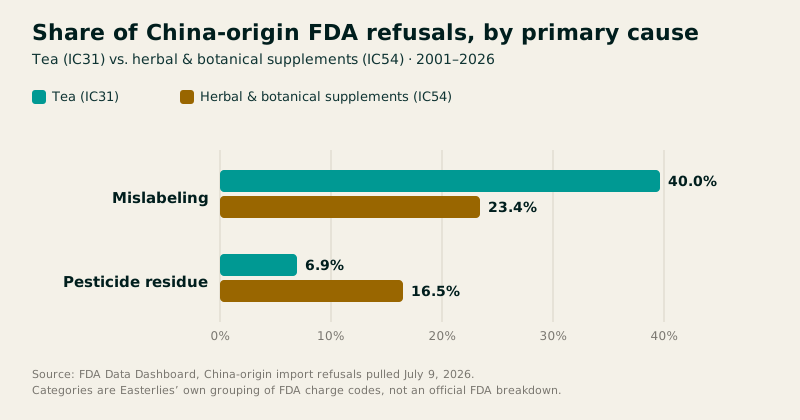
These rules are actively enforced. FDA refusal data for China-origin tea confirms this: chemical or heavy-metal findings account for 13.8% of refusals, while pesticide residues account for another 6.9%.
Against this backdrop, a thin file is a red flag. A reviewer is not just asking if a specific shipment is contaminated; they are asking if the supplier's system is capable of catching contamination. A spec sheet without a hazard analysis or a fixed testing calendar provides no answer. While the factory had real floor-level practices like metal detection and GMP, they were not documented for a remote reviewer.
The reviewer's hesitation is pattern-matching. In a category where heavy metals and pesticides are documented concerns, a supplier who cannot demonstrate their testing logic is treated as a supplier with something to hide.
Translating Floor Practice into Auditable Evidence
The solution was not to implement new safety practices, but to translate existing ones into a structure a reviewer could use. We built a hazard and risk register compatible with GFSI (Global Food Safety Initiative) standards, covering three critical hazard classes: heavy metals, pesticide residues, and microbiological risk.
Each entry specified the hazard, the likelihood, the existing control, the evidence on file, and the residual risk. This transformed the factory's claims into a checklist a QA desk could verify line by line.
We then replaced the folder of disconnected lab reports with a forward-looking testing plan. By tying specific panels and lab frequencies directly to the hazards in the register, we shifted the narrative from a few lucky tests to a managed system. To support this, we coordinated an introduction to an ISO/IEC 17025 accredited third-party lab for the client to engage directly. This ensured the results were technically reliable and tea-specific. Within this consulting assignment, Easterlies did not choose the testing methodology, interpret results as a pass/fail authority, or act as the client's FSVP importer of record. That client boundary is separate from Easterlies' importer and FSVP role for its own distributed matcha. We provided the register and the calendar; the accredited lab provided the data.
Defining the Win: Legibility Over Luck
We further refined the register by mapping it against the specific numeric thresholds of the target buyer's channel. This allowed the client to distinguish between legally binding limits and channel-specific preferences, ensuring they did not over-prepare for the wrong metrics.
The result was a narrow but significant victory: the buyer's file status moved from unreadable silence to 'received, complete, and under technical review.' For the first time, the client could answer a specific question, such as lead testing frequency, with a documented record instead of a scramble.
This engagement did not guarantee approval, secure a specific order, or change the product's actual safety profile. The record did not create new controls; it made existing ones legible. The powder was never the risk. The blank space next to the testing plan was. A documented, audited structure closes those blank spaces one line item at a time.
Scope
- 01 Gap-scoping to separate documentation failures from safety failures
- 02 GFSI-format hazard and risk register for heavy metals, pesticides, and microbes
- 03 Forward-looking testing plan mapped to identified hazards
- 04 Specialist coordination with an accredited third-party lab
- 05 Mapping of buyer-specific numeric thresholds for the target channel
The outcome
The buyer's file status moved from 'no response/soft rejection' to 'received, complete, and under technical review.' This was a documented status change, not a final sales outcome. The client now possesses a structured hazard register and a forward testing calendar. We make no claim of guaranteed approval or changes to the product's safety profile; the record simply organized and evidenced controls that were already in place.
What to take from this
- Silence from a QA reviewer often indicates a documentation gap rather than a product failure.
- Botanical powders from China face high scrutiny via FDA Import Alerts (e.g., 99-42) and DWPE.
- A GFSI-compatible hazard register converts unwritten floor practices into auditable evidence.
- Proper documentation organizes existing controls; it does not invent safety or guarantee approval.
When a buyer's QA desk goes silent without naming a specific failure, the gap is often in the evidence trail, not the product. Implementing a GFSI-format hazard register and a forward testing calendar can turn silence into a decision by making real controls legible to the reviewer.
Glossary
- Import Alert / DWPE
- An FDA Import Alert flags specific categories, such as China-origin tea, as high-risk. This can trigger Detention Without Physical Examination (DWPE), where shipments are held automatically unless the importer provides prior evidence of safety.
- ISO/IEC 17025
- The international standard for testing and calibration laboratory competence. Accreditation ensures a lab's results are technically valid and trusted by professional QA reviewers.
- Hazard and Risk Register
- A structured document that identifies food-safety hazards, assesses their likelihood, lists the controls in place to mitigate them, and identifies the evidence available to prove those controls work.
- GFSI
- The Global Food Safety Initiative. While it does not certify factories, it recognizes specific certification schemes. GFSI-compatible documents follow the structure that global buyers expect and trust.