When Unknown Status Equals High Risk
Turning sound capabilities into a buyer-filable US record.
Easterlies · July 4, 2026 · 5 min read
Summary
The product was sound, but the evidence was unreadable. By securing FDA registration, appointing a U.S. Agent, and rebuilding the documentation into an FSVP-compliant English format, we closed the compliance gap in weeks.

Four questions, zero ready answers
The critical moment arrived as a pre-qualification request from a US importer who already liked the product. The importer required four items: an FDA foreign facility registration number and U.S. Agent, a recent third-party audit report, a certificate of analysis (CoA) for heavy metals and pesticides against US limits, and a signed statement for the importer's Foreign Supplier Verification Program (FSVP) file.
The factory had the capability to answer but lacked the documentation. Batch CoAs existed, but they were not standardized to US limits. A domestic Chinese food-safety license was current, but because it was not a GFSI-benchmarked scheme like SQF or BRCGS, it did not satisfy the audit requirement.
Furthermore, there was no FDA registration because the factory had not been informed that registration and a U.S. Agent are mandatory before food enters the US. Similarly, there was no position on California's Proposition 65 lead thresholds because they had never been asked.
The deal did not die; it went quiet. This is the most dangerous outcome: no formal rejection to appeal, just a half-answered questionnaire sitting in an inbox while a viable product remains unshippable.
A blank field and a real risk look identical to a QA reviewer who has to file something either way.
The plant was never the problem
It is important to distinguish unreadable from unsafe. The extraction and spray-drying lines were fully operational and domestic licenses were valid. The problem was a lack of US-legible records.
FDA registration and the appointment of a U.S. Agent are non-negotiable administrative requirements, not quality judgments. Any foreign facility handling food for US consumption must register and designate a US-based point of contact. Without a confirmed U.S. Agent, registration is impossible. A factory without one is not in a gray zone; it is simply unregistered, which is a hard disqualifier on any importer's form.
Certification follows a separate logic. Under FSVP regulations, the legal burden falls on the US importer, but they cannot discharge that burden without verification evidence from the factory. A domestic license, however genuine, is not benchmarked against GFSI standards. This does not mean the factory's safety practices are weak; it means they are not written in the evidentiary language the importer requires.
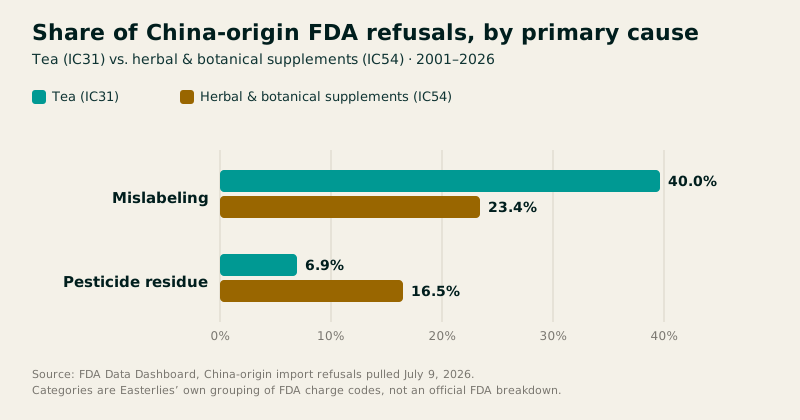
Finally, the testing gap was a matter of formatting. Because tea-derived ingredients fall under FDA import-alert categories for heavy metals and pesticides, QA reviewers look for specific numbers mapped against US limits. A CoA that reports a result without referencing the relevant US limit or a Prop 65 calculation is read as absent evidence. FDA refusal data for China-origin tea shows that mislabeling and paperwork errors cause 40.0% of refusals, compared to only 6.9% for actual pesticide residues.
Building a channel-grade record
We did not start with a rewrite; we started with a scope. We provided a scored list covering registration status, certification posture, and documentation maturity, including the cost to close each gap. This ensured the factory knew exactly what was missing before committing resources.
We then rebuilt the existing Chinese-language HACCP plans and batch CoAs into a QA-reviewer-formatted package. This included a hazard analysis mapped to FSVP vocabulary, standardized spec sheets, and a document index. We did not invent new safety practices; we translated existing ones into a form the buyer could act on.
To optimize the budget, we separated mandatory requirements, such as FDA registration, U.S. Agent, and allergen declarations, from channel-preferred ones like Kosher, Halal, or specific GFSI schemes. This allowed the factory to invest in certifications strategically rather than defensively. For regulated third-party acts, such as the FDA filing and lab testing, we coordinated the handoff to licensed specialists. We did not act as the U.S. Agent or the lab; those functions remained with the licensed professionals.
Results: Legibility as a competitive advantage
The outcome was a professional, buyer-filable response. By securing a responsive U.S. Agent and FDA registration, we cleared the primary hard disqualifier. The evidence file was reorganized to be decision-useful, featuring an English hazard analysis and contaminant testing with Prop 65 calculations. By distinguishing mandatory from preferred certifications, the factory avoided paying for schemes their target buyers did not actually require.
To maintain honesty in the process, we clarify what we did not do in this consulting assignment: we were not the client's FSVP importer, certifying body, or lab. That client boundary is separate from Easterlies' importer and FSVP role for its own distributed matcha. GFSI certifications, if pursued, still operate on a 6-to-12-month timeline independent of this record. We did not contact the importer on the factory's behalf or claim a relationship with them.
The product was never the risk. The risk was a blank field on a QA form, which defaults to no. By making the file legible, we did not change what the factory could produce; we changed whether the buyer could tell.
Scope
- 01 Gap-scoping against four critical buyer requirements: FDA registration, a U.S. Agent, a recognized audit report, and contaminant testing against US limits.
- 02 Rebuilding Chinese-language evidence into an English, QA-formatted file designed for rapid reviewer navigation.
- 03 Distinguishing mandatory regulatory requirements from channel-preferred certifications to optimize certification spend.
- 04 Specialist coordination with a U.S. Agent, a contaminant-testing lab, and a certification body (acting as coordinator, not provider).
The outcome
The supplier now possesses a buyer-filable record. By securing FDA registration and a responsive U.S. Agent, we eliminated the primary hard disqualifier. The resulting evidence file is now marked as decision-useful by QA reviewers. While we make no promise of a guaranteed order, the supplier now has a file that withstands the rigorous review process that previously stalled their deals.
What to take from this
- Stalled deals often signal a documentation gap, even when the product is sound.
- FDA registration cannot be completed without a confirmed, responsive U.S. Agent.
- Avoid defensive spending; certify only for the specific schemes your target buyers require.
- Paperwork and mislabeling cause significantly more FDA refusals for China-origin tea (40%) than actual pesticide residues (6.9%).
When a quality product receives a soft no from a buyer, determine if the gap is in the product or the paperwork. Legibility is a technical hurdle that can be fixed in weeks, not years.
Glossary
- FDA facility registration
- The requirement for foreign facilities producing food for U.S. consumption to register with the FDA and renew every two years. A missing registration is an immediate disqualifier.
- U.S. Agent
- A US-based contact designated by a foreign food facility for FDA communication. A confirmed U.S. Agent is a prerequisite for successful FDA registration.
- GFSI
- The Global Food Safety Initiative. It recognizes various certification schemes (e.g., SQF, BRCGS) as meeting a global standard, allowing buyers to accept any recognized scheme.
- Prop 65
- California's Proposition 65, requiring warning labels if a product exceeds specific thresholds for chemicals like lead. This is a labeling requirement, not a safety condemnation.
- Mislabeling (FDA refusal category)
- FDA shipments refused due to paperwork or labeling errors rather than contamination. This is the leading cause of refusals for China-origin tea.