Knowledge
North American Food Export: The QA Checklist
Avoid onboarding delays with these core documents.
By Grace Luo · reviewed by Leon Liang · July 7, 2026 · 3 min read

The short answer: North American onboarding almost always starts with FDA facility registration, then the importer’s FSVP file, then labels and batch-specific CoAs. Individual buyer checklists vary; those categories do not.
Most first-time exporters discover a buyer’s QA requirements mid-negotiation—usually when a short deadline is attached. While every buyer’s checklist varies, the following categories are the universal baseline for North American onboarding.
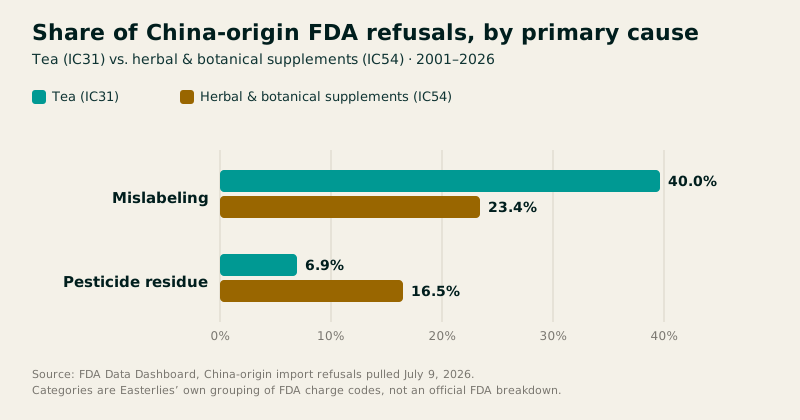
In our review of FDA import-refusal data, mislabeling accounted for 40.0 percent of China-origin tea refusals, while pesticide residue—the primary concern for most suppliers—accounted for only 6.9 percent.
FDA Facility Registration
Any facility outside the US that manufactures, processes, packs, or holds food for US consumption must register with the FDA and renew every two years.
This is a legal registration, not a quality endorsement. However, a buyer’s compliance team will request your registration number early; without it, the process stops.
The Foreign Supplier Verification Program (FSVP)
Under FSMA, the legal burden of verifying food safety rests with the US importer of record, not the supplier.
In practice, the importer fulfills this obligation using your documentation. They will review your:
- Hazard analysis
- Process controls
- Testing records
Suppliers who have these organized in advance move through onboarding significantly faster than those assembling them on request.
GFSI-Recognized Certification
Large retail and foodservice buyers increasingly require certification under a scheme recognized by the Global Food Safety Initiative (GFSI), such as SQF, BRCGS, or FSSC 22000.
While not every buyer requires this, many treat it as a prerequisite for entry. If you are targeting tier-one retail accounts, confirm the buyer’s preferred scheme before investing in an audit.
Credible Certificates of Analysis (CoA)
A CoA must be batch-specific to be useful. A professional reviewer expects to see:
- Lot number
- Test date
- Testing laboratory
- Actual measured results (compared against a stated limit)
Avoid generic, undated CoAs or those stating “results on file” without providing the actual data. Experienced QA reviewers spot these gaps instantly, and it is a fast way to lose credibility.
Contaminant and Heavy-Metal Screening
For tea, lead and cadmium levels are high-priority items. This scrutiny is driven largely by California’s Proposition 65, which requires warnings for chemicals exceeding specific thresholds.
Even if your product doesn’t require a warning label, QA teams typically demand recent heavy-metal test results during onboarding, particularly for the first order.
US-Format Labeling (Beyond Translation)
A common mistake is assuming a translated Chinese label is a US-compliant label. A Nutrition Facts panel built to FDA formatting rules is a distinct technical document.
This distinction is critical, as the numbers above show. See the full data breakdown for the methodology.
The most frequent format gaps include:
- Nutrition Facts Panel: Differences in serving size conventions, rounding rules, and required nutrient lists.
- Country-of-Origin: Specific requirements for placement and wording.
- Allergen Declarations: Must follow the US-specific format, not just a translated list of ingredients.
Buyers will flag any label that contains the correct information but fails to follow the US template.
Organizing this paperwork before the first conversation separates fast onboarding from slow onboarding. A supplier who provides a clean registration number, a valid CoA, and a clear certification status is materially more competitive than one who has to “go find” those documents.
FDA facility registration, FSVP, and Prop 65 are three distinct regimes. The side-by-side is FDA facility registration vs. FSVP vs. Prop 65.
About Easterlies
We built Easterlies to carry matcha from producer to wholesale buyer. The same bilingual team still helps tea and food businesses navigate the Pacific.
Request samples