Knowledge
Mislabeling: The Leading Cause of FDA Tea Refusals
Insights from 20 years of FDA import-refusal data.
By Grace Luo · reviewed by Leon Liang · July 9, 2026 · 5 min read
The short answer from Easterlies’ review of FDA import-refusal data: of 305 China-origin tea refusals since 2001, mislabeling accounted for 122 refusals (40.0%). Pesticide residue, the primary fear, accounted for only 21 refusals (6.9%).
We analyzed FDA import-refusal data for China-origin tea and China-origin herbal/botanical supplements, covering more than 300 tea refusals and 2,000 supplement refusals since 2001. Of the 305 China-origin tea refusals in the dataset, the leading cause is mislabeling: 122 refusals (40.0%). By contrast, pesticide residue, the primary fear, accounted for only 21 refusals (6.9%).
Ask a Chinese tea exporter—or the buyer vetting one—about the biggest FDA risk, and “pesticide residue” is almost always the first answer. It is the headline story: illegal chemicals, Import Alert 99-08, and shipments turned back because of a mistake upstream. For tea leaves, however, that is rarely the case. The data reveals a pattern that is more specific, and far more fixable, than a general fear of pesticides.
The Data Source
FDA logs every refused shipment with a specific charge code (e.g., missing English labeling, undeclared allergens, or pesticide residue). We extracted every China-origin refusal from 2001 through mid-2026 under two categories:
- Industry Code 31: Coffee and Tea
- Industry Code 54: Herbal and botanical “teas” (e.g., chrysanthemum, goji, ginseng, and extracts)
We then grouped these charge codes into categories: mislabeling, pesticide residue, and chemical or heavy-metal contamination.
Note: This grouping is our own interpretation of FDA charge codes, not an official FDA breakdown. For primary source verification, we recommend checking FDA records directly. Be precise with codes: tea is IC31; IC24 is for vegetables.
This trend remains current. 2025 was the second-highest year on record for tea refusals, with annual counts consistently landing between 10 and 30 since 2008.
The Primary Culprit: The Label
The recurring gaps are simple:
- Missing English-language labeling
- Missing or incorrect Nutrition Facts
- Absence of an ingredient list
- No importer or firm name on the package
Chemical or heavy-metal findings (primarily melamine or “poisonous” charges) were more common than pesticide residue, with 42 refusals (13.8%).
If you supply tea: A compliant US-format label is the fastest, cheapest fix, outweighing the immediate need for a lab test. This means English text, a Nutrition Facts panel following US rounding and serving-size rules, a full ingredient list, and your firm’s name. None of this requires a chemist.
If you buy tea: Request the actual label artwork the supplier intends to use. A spec sheet with correct English is not a compliant US label; that gap is where many shipments are stopped.
The Second Gap: Paperwork, Not Product
The second-largest cause of refusal is a specific administrative failure. 62 of the 305 tea refusals (20.3%) were cited for both a missing Food Canning Establishment (FCE) registration and a missing scheduled-process filing.
These requirements fall under 21 CFR Parts 108 and 113 for low-acid canned and acidified foods. This is almost exclusively a problem for ready-to-drink (RTD) or bottled tea; 35 of the 305 refusals in the dataset were specifically coded as liquid tea.
If you ship bottled tea into the US, this registration is a mandatory step. While FDA files this under “adulteration” rules, it is a paperwork requirement, not a reflection of the tea’s purity.
Where the Pesticide Fear is Justified
The risk profile shifts dramatically when you move from tea leaves to herbal and botanical supplements (ginseng, goji blends, botanical extracts). Filed under Industry Code 54, these products face a very different set of challenges.
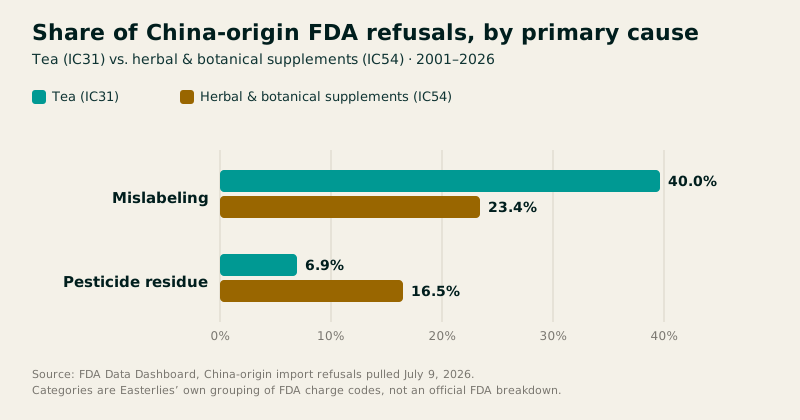
| Measure | Tea (IC31) | Herbal & botanical supplements (IC54) |
|---|---|---|
| China-origin refusals, 2001 to mid-2026 | 305 | 2,167 |
| Top cause: mislabeling | 40.0% | 23.4% |
| Pesticide residue specifically | 6.9% | 16.5% |
Pesticide residue accounts for 358 of 2,167 supplement refusals (16.5%)—more than double the rate for tea. Broader adulteration (pesticides, microbial contamination, and heavy metals) is the dominant cause overall at 64.6%.
For those supplying or buying botanical blends: Your compliance strategy must differ from that of loose-leaf tea. Contaminant testing and sourcing controls require a dedicated budget. A chrysanthemum “tea” is classified as a supplement/extract by the FDA, and the risk follows that classification, not the word “tea” on the box.
The “Unapproved Drug” Trap
Within herbal and botanical supplements, 223 refusals (10.3%) fall into an “other” category dominated by a single charge: UNAPPROVED.
This occurs when a product’s marketing makes a disease or treatment claim so strong that the FDA reclassifies the food as an unapproved new drug. Across the full dataset, this charge appears 379 times.
This is the “claims landmine” we detailed in our case study. Terms that seem like standard marketing in other markets—“detox,” “lowers blood pressure,” or “boosts immunity”—can cross a legal line in the US. When a structure-and-function claim becomes a disease claim, the product becomes an illegal drug.
Easterlies view — The most common mistake is treating “FDA compliance” as a single, vague risk to be insured against. In reality, it is a sequenced list of specific fixes. For loose-leaf tea, the label is the priority: it is cheap, entirely controllable, and the most common point of failure. For bottled tea, FCE registration is the critical hurdle. For botanical blends, the data suggests investing in testing over labeling. We help clients identify which of these risks actually apply to their specific product so they stop spending money on the wrong fixes.
Summary: Order of Operations
- Loose-leaf or bagged tea: Fix the label first. It is the most frequent cause of refusal and is entirely within the supplier’s control.
- Canned or bottled tea: Verify that FCE registration and process filings are complete, not just “in progress.”
- Herbal or botanical blends: Prioritize budget for contaminant testing and sourcing verification. This is where the “pesticide risk” actually lives.
- Any product with marketing copy: Conduct a claims review. Ensure your language doesn’t accidentally reclassify your food as a drug.
We are not a lab, a labeling agency, or legal counsel. However, we can help you determine which of these steps apply to your product before you commit resources. If that is useful, get in touch. If you aren’t ready yet, we’ll tell you that, too.
About Easterlies
We built Easterlies to carry matcha from producer to wholesale buyer. The same bilingual team still helps tea and food businesses navigate the Pacific.
Request samples