The Five-Figure Cost of Missing a Requirements Map
A manufacturer avoids blind certification spend by mapping buyer needs.
Easterlies · May 30, 2026 · 6 min read
Summary
A factory nearly spent five figures on a top-tier certification before discovering that none of its immediate buyers required it, and that one of its target channels was structurally closed to new suppliers.

One word, three different meanings
For this factory, one quarter brought three emails that seemed to describe the same problem. A regional bubble-tea chain's supply manager asked if they were SQF. A boba-ingredient distributor's vendor form requested a GFSI certificate or an acceptable equivalent. A specialty retailer's portal blocked product reviews entirely until a food-safety audit was uploaded. To the owner, these were three different names for the same demand.
Following a common instinct among under-advised manufacturers, the owner assumed the safest move was to acquire every certification mentioned. He began pricing a full SQF Level 3 build, the top tier of a GFSI-recognized scheme. The quote was in the five figures, with a projected timeline of six to twelve months. He was prepared to commit this capital and time before any of the three buyers had confirmed in writing that SQF specifically was their requirement.
This is where a requirements map interrupts the reflex. Certification is not inherently bad, but "get everything" is not a strategy. It is an expensive substitute for one.
Three buyers said three different things. The factory heard one word: certify everything. The map said something else: certify for the door that's actually open.
The channel that was never open
The first step was determining which of the three buyers, plus a fourth potential channel, actually had an open door for a new upstream supplier. The café chain appeared to be the most obvious prospect, but the mapping revealed a structural barrier.
Major U.S. bubble-tea franchises utilize centralized sourcing. Franchisees typically cannot shop the open market for syrup or powder; they must purchase from the franchisor or an approved list. Many of these chains operate in-house labs to vet every shipment before it reaches a store.
Because of this, the store manager asking about SQF was not the actual qualifying counterparty. The central procurement function is the decision-maker, and that function is a hard-to-reach target that does not publish onboarding checklists. This finding did not kill the café channel; it redirected it. For a factory of this size, the real entry point into bubble-tea retail is through the ingredient distributors who already supply the franchises. Redirecting energy away from a closed door and toward an open one was the most valuable outcome of the mapping, outweighing any downstream certification decision.
Three floors, three different heights
With the café channel reframed, we analyzed the remaining channels. We found that actual requirements existed in three distinct tiers.
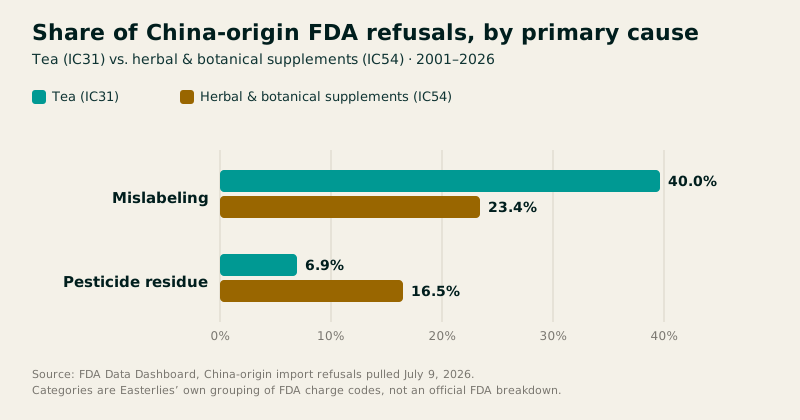
The distributor channel had no published factory-qualification criteria for the specific targets. While general industry guidance points toward ISO 22000, HACCP, and FDA registration, these are patterns, not mandates. However, the mapping surfaced a critical risk: an FDA warning letter issued to an unrelated Asian boba processor for shipping acidified, flavored pearls without the required process filing. FDA refusal data confirms this is a systemic issue: 20.3% of China-origin tea refusals cite missing Food Canning Establishment (FCE) registrations or scheduled-process filings.
The co-packer and private-label channel operates on a different floor entirely, governed by regulation rather than buyer preference. The Foreign Supplier Verification Program (FSVP) places the legal burden on the U.S. importer. To discharge this burden, the importer requires a hazard analysis and verification evidence from the factory. Requests for spec sheets, Certificates of Analysis (CoA), and allergen declarations are not arbitrary hoops; they are the importer managing their own legal exposure.
Finally, the specialty-retail channel, accessed via natural-grocery networks, carried the highest bar: a passed third-party audit from a GFSI-benchmarked scheme, renewed annually. This is a documented floor. In this specific channel, the SQF certification the factory had already priced would have been the correct move, provided this was the priority channel.
Certifying on purpose, not by reflex
The four-channel map separated what was legally binding from what was buyer-preferred and what was unnecessary. The café chain was not a direct target. The distributor channel had a narrow technical gap to close, not a certification requirement. The co-packer route required FSVP evidence, not a specific scheme name. Only the specialty-retail channel gated on the expensive certification the factory had nearly bought.
The work then sequenced itself. We prioritized the two highest-evidence disqualifiers: confirming the flavored SKU's process-filing status against the acidified-food rule and documenting a standing lab-testing cadence for the core product line. Both closed gaps that a distributor's QA team would have eventually caught, but on the distributor's timeline, not the factory's.
The GFSI certification did not disappear; it moved to the back of the queue, correctly scoped to the one channel that required it and coordinated through a licensed certification body. Our role was to identify which door was open, which floor applied, and which spend could wait, not to act as the certifier, importer, or auditor. By replacing reflex with a map, a five-figure decision became a strategic choice.
Scope
- 01 Analyzing the "over-certification" instinct and its triggers
- 02 Mapping requirements across four distinct channels: café chain, ingredient distributor, co-packer, and specialty retailer
- 03 Prioritizing record-building against the two disqualifiers with the highest evidence requirements
- 04 Coordinating specialists for acidified-food process filing and future certification bodies
The outcome
The factory shifted its outreach from a closed channel to two with documented application routes. We established a written lead-testing cadence for the tapioca-pearl SKU, moving the product from "no evidence" to a reviewable plan. The acidified-food filing gap was closed via a process authority before it could cause a shipment rejection. Most significantly, the factory avoided a premature, five-figure certification spend on a scheme their actual buyers did not require. No specific sales, orders, or placements are claimed.
What to take from this
- "Get every certification" is a costly substitute for a distribution strategy.
- In centralized franchise systems, store-level inquiries often do not reflect actual procurement requirements.
- Compliance requests (Spec sheets, CoA, allergen declarations) are tools for the importer to manage FSVP legal exposure.
- Channel-by-channel mapping prevents premature capital expenditure on unnecessary certifications.
When multiple buyers mention certification, resist pricing the top-tier version until you verify if they are the same buyer type or even a channel open to new suppliers. A standards map that separates legal mandates from buyer preferences usually costs a fraction of the spend it prevents.
Glossary
- GFSI
- The Global Food Safety Initiative. It does not certify factories directly; it recognizes a handful of food-safety certification schemes (SQF and BRCGS among them) as meeting the same bar, so a buyer can accept any one of them instead of demanding one specific scheme.
- SQF
- Safe Quality Food, one of the specific certification schemes recognized under GFSI. It comes in tiers, with Level 3 being the highest. It is one of the schemes North American retail buyers most commonly ask for, though not every buyer needs the top tier.
- FSVP
- The Foreign Supplier Verification Program, an FDA rule that puts the legal responsibility for verifying a foreign supplier's food safety on the US importer, not on the factory. In practice, the importer can only meet that responsibility if the factory provides a hazard analysis and testing evidence in the format the importer's own file needs.
- FCE registration / process filing
- Food Canning Establishment (FCE) registration and scheduled-process filing are FDA paperwork required before an acidified or low-acid canned food, such as a flavored, shelf-stable pearl or syrup, can be sold in the US. It is a narrow, category-specific requirement separate from general food-safety certification.